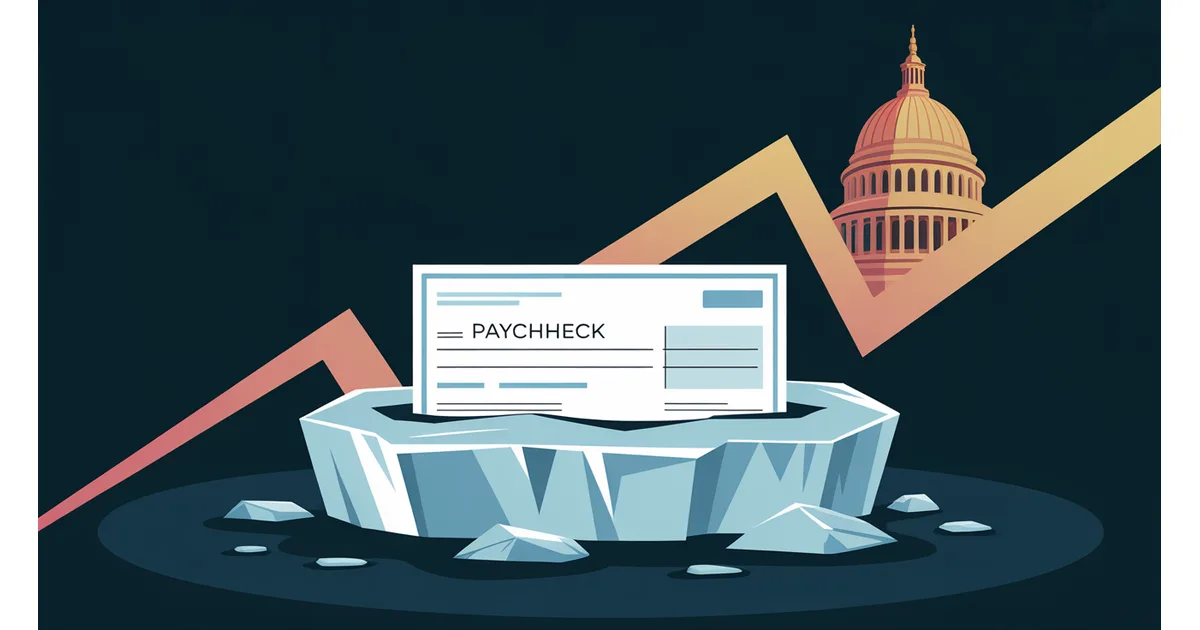
The Raise That Arrives by Default: What Congress's Frozen Paycheck Teaches Every W-2 Worker
Congress has had an automatic cost-of-living raise since 1989 and declined it every year since 2009, freezing member pay at 174,000 dollars, about a third less now.
You know the ritual. Once a year you sit across from a manager, or you wait for a number to land in an email, and you find out what your work is worth for the next twelve months. Maybe you built a case. Maybe you rehearsed the ask. Either way, the raise is not yours until someone above you signs off on it. That is the basic fact of a salaried life: your pay moves when your employer decides it moves, and not a day sooner.
Now picture the opposite. Picture a job where the raise is already written into the rules. It arrives on its own every January. You do not have to ask, you do not have to justify it, you do not even have to vote for it. It simply shows up unless you stand up and stop it.
That job exists. It belongs to the 535 members of the United States Congress. And every year since 2009, they have stood up and stopped it.
The one paycheck with a raise built in
Here is the mechanism, and it is real. The Ethics Reform Act of 1989 gave members of Congress an automatic annual salary adjustment tied to the Employment Cost Index, the same private-sector wage gauge this site comes back to often, capped at whatever raise federal General Schedule workers get. Under the law, that adjustment takes effect by default. A member never has to cast the politically radioactive vote to give himself a raise. The raise just happens, unless Congress passes something to block it (Congressional Research Service).
So Congress blocks it. Every year since 2010, usually with a one-line rider buried in a spending bill, the legislature has waved off its own scheduled increase. The last time member pay actually moved was January 2009, a 2.8 percent bump to 174,000 dollars. It has not budged since. The Congressional Research Service puts the damage in plain terms: adjusted for inflation, member salaries fell about 33 percent from 2009 through 2025. Had the automatic raises simply been allowed to run since 1992, CRS estimates the salary would sit near 247,400 dollars today instead of 174,000. That is a counterfactual, not a real check, but it measures the raise Congress keeps refusing: roughly 73,000 dollars a year.
If you have ever walked out of a review with a two percent bump and quietly called it a loss to inflation, sit with that number for a second. This is the one worker in the country who could have the cost-of-living raise handed to him automatically, and he keeps signing the form that cancels it.
Why it is not the simple outrage it looks like
It would be easy to stop there and call it hypocrisy. It is more interesting, and more honest, to notice why the story does not actually break the way the headline wants it to.
First, the freeze is nominal, not a cut. The 174,000 dollar figure has never gone down. Only inflation makes it worth less each year, the same slow erosion that eats an un-adjusted salary anywhere. Second, the money saved is a rounding error. A few hundred members times a few tens of thousands of dollars, set against a federal budget measured in trillions, does not move anything. Whatever the freeze is buying, it is not fiscal discipline in any real sense.
What it buys is a headline that never gets written. "Congress declines its raise" is a story no one runs. "Congress votes itself a raise" is a story that ends careers. So the number sits frozen, and the members absorb a real decline in what their salary is worth, in exchange for never having to defend the optics of taking what the law already offers them.
And there is a cost to that theater, even if you have no sympathy for the people paying it. A salary that shrinks in real value every year quietly tilts the job toward people who do not need it, and strengthens the pull of the far more lucrative world outside the building. That is worth keeping in mind before we get to where the actual money is.
The judges who kept their raise
The cleanest proof that the freeze is a choice and not a law of nature sits one branch of government over. Federal judges get the very same kind of automatic cost-of-living adjustment the Ethics Reform Act created. Theirs was never frozen, because the courts ruled it could not be.
In Beer v. United States, decided in 2012, the Federal Circuit held that the 1989 law made a precise and definite promise to pay sitting judges an automatic annual COLA, and that blocking those adjustments violated the Compensation Clause of the Constitution, which forbids cutting federal judges' pay while they serve (case summary). So judges get their inflation raise as a matter of constitutional right. A federal district judge now earns 247,400 dollars, a circuit judge 262,300, an associate Supreme Court justice 303,600, and the chief justice 317,500 (Administrative Office of the U.S. Courts).
Look at the first of those numbers again. A trial-court judge now out-earns a member of Congress by more than 70,000 dollars, almost exactly the gap the freeze has opened, and for one reason: one branch took the indexed raise and the other refused it. There was no fiscal crisis on the judicial side. The pay held its value and the sky did not fall. Congress could have the same arrangement tomorrow. It votes no instead. This is a natural experiment, and it settles the question: the freeze is a preference, not a constraint.
What this teaches about who controls a wage
Here is where the frozen paycheck stops being a story about politicians and starts being a story about you.
Line up three kinds of American income. A Social Security recipient cannot vote themselves a raise, and does not have to: the law grants the cost-of-living adjustment automatically, which is why those checks rose about 27 percent just over 2021 through 2026 (Social Security Administration). A federal judge cannot be denied a raise: the Constitution forbids it. A salaried W-2 worker sits at the far end of that line with no automatic adjustment of any kind, forced to extract every raise by hand from an employer who is free to say no. That difference, between a raise written into the rules and a raise you have to win, is the whole ballgame, and it is the subject of the gap between a cost-of-living bump and a merit raise.
Congress sits in the strangest spot of all: handed the automatic raise by statute, blocked by no constitution from taking it, and declining it anyway. Which points at something the annual-review ritual usually hides. The thing that decides whether your pay keeps up with the cost of living is almost never the headline dollar figure. It is whether an escalator is written into the arrangement, and who holds the switch. A benefit indexed by law keeps up. A wage that depends on a yes keeps up only when someone says yes. If you have ever wondered why W-2 workers stay broke while indexed benefits quietly compound, this is a large part of the answer: no switch, or a switch somebody else controls.
Where the real money actually is
There is one more correction, and it is the most important one for anyone tempted to envy or resent that 174,000 dollars. The salary is the least of it.
Members of Congress are, as a group, a lot wealthier than the people they represent. The median member's net worth has hovered around a million dollars in recent disclosure years, several times a typical household, though those figures are estimates built from the broad ranges disclosures use and are skewed hard toward a rich handful at the top (OpenSecrets). More to the point, the biggest financial rewards of the office tend to arrive after it, and legally. Public Citizen found that of the former members who took private-sector jobs in a recent stretch, nearly two-thirds went into lobbying, consulting, or advocacy work that turns on federal policy (Public Citizen). One much-cited analysis put the average pay jump from a member's last year in office to their lobbying compensation at more than 1,400 percent, a figure driven by a few spectacular outliers and best read as illustrative rather than typical (The Nation). Board seats, book advances, and speaking fees fill in the rest of the pattern. The office is a platform, and the platform pays later.
None of that is an accusation. It is legal, it is disclosed, and it is exactly the point. Congress freezes the one number voters actually see, the visible paycheck, while the real money moves through wealth brought into the job and earned after leaving it. That is the same move, scaled up, that runs quietly underneath a lot of ordinary financial life, the one I've called the W-2 wealth transfer: the figure on your pay stub is managed and visible, and it is almost never where the wealth is actually being decided.
The takeaway for your own paycheck
You are not going to get an Ethics Reform Act written for your job. No statute is going to index your salary to the Employment Cost Index, and no Compensation Clause is going to stop your employer from letting it slide. That is the hard part of the comparison. But the frozen paycheck on Capitol Hill still teaches the one lesson that matters most for a salaried life: a wage without an escalator erodes, quietly and automatically, and the only real question is who controls the switch.
For Congress, the answer is themselves, and they keep it flipped off for the optics. For you, the answer is your employer, until you build income that does not depend on anyone's yearly yes. That is the argument at the center of The W-2 Trap: the paycheck is the most controlled, most visible, and least wealth-building number in your financial life, and the way out is to stop treating it as the main event. Congress already knows that. It is why they let the salary freeze and never blink.