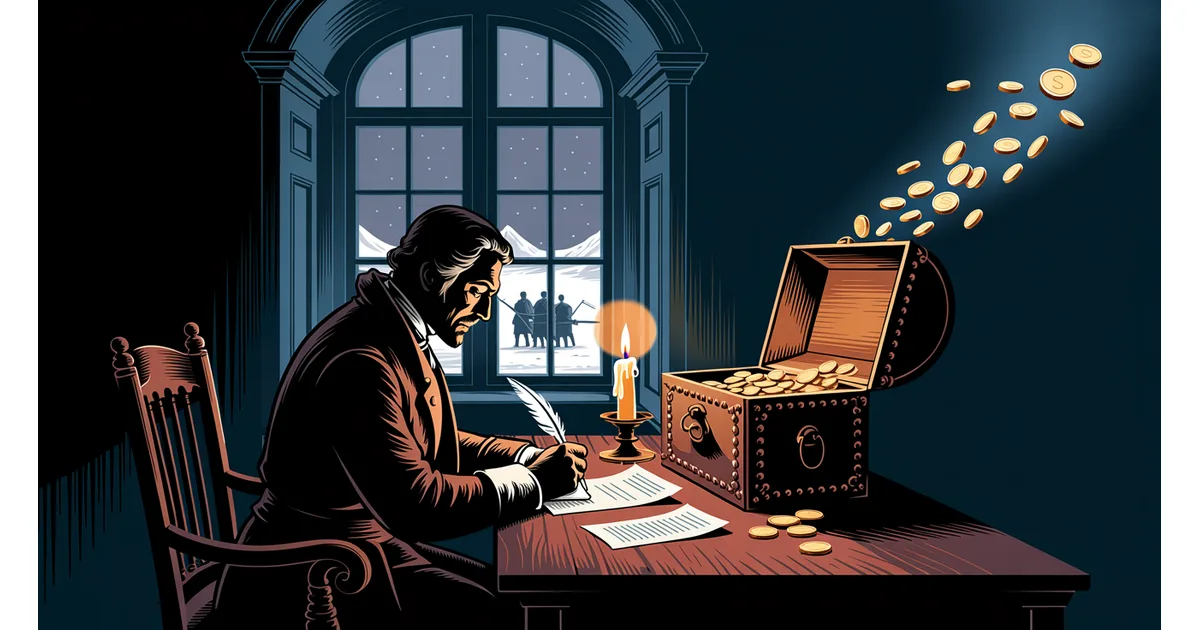
The Man Who Personally Bankrolled the American Revolution Died Broke
Robert Morris put 1.4 million dollars of his own credit behind Yorktown and signed all three founding documents. By 1798 he was in debtors' prison. The mechanics that broke him still operate.
In 1781 the American government was broke. Not metaphorically broke. The Continental Congress could not feed its own army, and the states, asked to contribute, mostly didn't. One Philadelphia merchant described begging them for funds as "preaching to the dead."
That merchant was Robert Morris, and Congress had just handed him a brand-new job: Superintendent of Finance, the office the American Battlefield Trust calls the precursor to the Treasury Secretary. His fix was not clever policy. His fix was his own name. Morris issued more than a million dollars in personal promissory notes so soldiers could eat, and when Washington needed to move the army south to Yorktown, the DSDI signer biography puts Morris's personal stake in the campaign at 1.4 million dollars. For roughly three years, one man's private credit substituted for a national currency.
It worked. The war was won, the country got its Constitution (Morris signed that too; he and Roger Sherman are the only two men who signed the Declaration, the Articles of Confederation, and the Constitution), and Washington offered him the first Treasury secretaryship. He turned it down and recommended his friend Alexander Hamilton instead.
Seventeen years after Yorktown, Robert Morris was in Prune Street debtors' prison in Philadelphia. He stayed three and a half years. He died in 1806 living on an annuity a friend arranged for him.
If you're building wealth on a salary, his story is not trivia. It's the oldest American case study in the difference between access to money and ownership of money.
How the richest man in the room got there
Morris's rise reads like the fantasy version of self-made. Orphaned at sixteen when a ceremonial cannon salute fatally injured his father, one year of formal schooling, a clerk's desk at a Philadelphia merchant house. He became a partner, built Willing, Morris & Company into a shipping and banking power, and at his peak was ranked (per the Encyclopedia of American Wealth, cited by DSDI) as one of the two richest of the 56 men who signed the Declaration.
Notice what the fortune was made of: ships, cargo, warehouses, and above all reputation. Merchants accepted his paper because Robert Morris had always paid. That's why his wartime notes worked as money when the government's money didn't.
How he lost it
After leaving the Senate in 1795, Morris went all-in on land. And "all-in" undersells it. He owned, at one point, the western half of New York State. With partners he held options on more than 6 million acres, plus building lots in the new capital city of Washington. The plan assumed a large loan from Holland to carry it all.
Then, per the DSDI account: the Holland loan never materialized once the French Revolution and Napoleon consumed Europe. Talleyrand bought 100,000 acres and simply never paid. Aaron Burr, acting as New York's attorney general, pressed a lawsuit that stripped Morris of hundreds of square miles. The Panic of 1797 arrived, creditors demanded payment at once, and the American Battlefield Trust puts his debts at nearly three million dollars. In February 1798 he entered debtors' prison, and a federal bankruptcy law freed him only in 1801.
Read that sequence again slowly, because every step has a modern name:
- Illiquid assets, short-term obligations: he held land measured in millions of acres and couldn't raise cash for creditors standing at his door. Land rich, payment poor.
- Financing assumed before it closed: the entire structure depended on a loan that was still theoretical. When it died, the structure died.
- Counterparty risk: one buyer's default (Talleyrand's unpaid 100,000 acres) punched a hole nothing else could fill.
- A macro shock he didn't cause and couldn't dodge: the Panic of 1797 turned a squeeze into a collapse.
- Personal guarantee: his signature was on everything. There was no wall between Robert Morris the investor and Robert Morris the human being who could be jailed for debt.
The uncomfortable lesson about credit
The young United States and the aging Robert Morris traded places, and the trade is the whole lesson. In 1781, the government had no credit and Morris had all of it, so his signature carried a war. By 1798, the government had established credit (using, incidentally, the funding blueprint Morris himself proposed in his On Public Credit plan, which DSDI notes became the basis for Hamilton's program a decade later), and Morris's signature couldn't keep him out of prison.
Credit is confidence, and confidence is a renter. It moves out without notice. Assets you own outright, income streams that don't depend on one buyer or one lender, cash that's actually cash: those stay.
That's the same distinction that runs through how currency devaluation quietly moves wealth from wage earners to asset holders, and it's why a six-figure salary can still leave you broke: high income, like high credit, feels like wealth while conditions are good and evaporates the moment they aren't.
What Morris would tell a W-2 earner
Nobody escapes a paycheck by borrowing their way out. Morris's fortune survived a war, 150 lost ships (his own count, per DSDI), and a congressional fraud investigation that ended in his exoneration. It did not survive concentration, borrowed money, and a timing bet. The wealthy families who actually keep wealth do close to the opposite: structure, trusts, and boring diversification across generations, and when they do borrow, they borrow against assets they never intend to sell rather than to buy things they can't carry.
There's one more detail worth keeping. Morris turned down the Treasury job that would have made him the architect of American finance with public money instead of his own. The man who took his recommendation, Hamilton, is on the ten dollar bill. The man who made it is a trivia question. Working with the system's money instead of against your own personal balance sheet turns out to be excellent career advice.
Robert Morris is not entirely forgotten, though. Painted into the U.S. Capitol dome in 1865, in the fresco called The Apotheosis of Washington, there's a Commerce scene the Architect of the Capitol describes as "Mercury handing a bag of money to Robert Morris, financier of the American Revolution." A god delivering a bag of gold to the man who died broke. The federal government has a sense of humor; it's just 180 feet up.
For the full framework on converting earned income into owned assets before confidence-based wealth fails you, that's the whole project of The W-2 Trap.
Fact-check notes and sources
- Superintendent of Finance role, "personally financed the American Revolution," Morris notes, precursor-to-Treasury framing, roughly 2,500 pound inheritance, nearly $3 million owed, prison 1798 to 1801, Panic of 1797: American Battlefield Trust, Robert Morris: Financier of the American Revolution
- Biographical detail (father's death, wealth ranking, "preaching to the dead," over a million dollars in personal notes, $1.4 million Yorktown stake, On Public Credit as basis for Hamilton's plan, declined Treasury and recommended Hamilton, western half of New York State, 6 million acres of options, Holland loan failure, Talleyrand default, Burr lawsuit, Prune Street, 150 ships lost, signed all three founding documents with Roger Sherman, 1801 release and annuity): DSDI, Robert Morris
- Capitol dome fresco Commerce scene, quoted description: Architect of the Capitol, Apotheosis of Washington
- Fresco symbolism background (Mercury's winged hat and caduceus as emblems of trade and negotiation): American Essence, The Apotheosis of Washington: Deciphering the Symbols of Our Nation. That essay describes the Mercury scene's symbolism; the identification of Morris as the figure receiving the money comes from the Architect of the Capitol page.
- Single-source figures (the $1.4 million Yorktown stake) are attributed inline to their source.
This article is informational, not financial advice. Historical institutions and publications are mentioned as nominative fair use; no affiliation is implied.